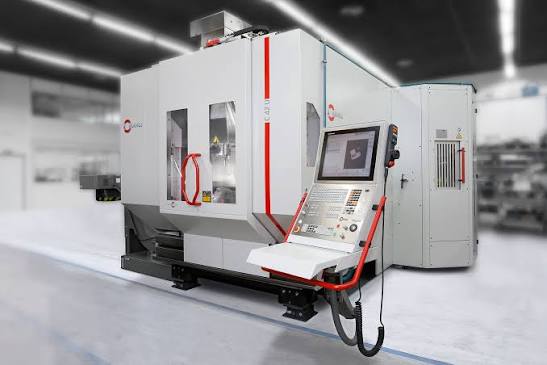
Like 4th axis machines, 5th axis machines also have their variations. The machines typically either use a rotation in the A-axis and C-axis or a rotation in the B-axis and C-axis. Both the workpiece and the spindle rotate in 5-axis milling. The two main types of 5-axis machining are simultaneous and 3+2 index milling.
For simultaneous milling, the cutting tool is in XYZ coordinates at the same time as the other two axes (A and C or B and C). This method allows highly complex 3D shapes and curves to be made. 3+2 does not have the two axes rotating at the same time. Instead, the rotation axes operate independently of each other, and the workpiece rotates to an angle in relation to the cutting tool. 5-axis machining allows manufacturers to create parts that were normally made using molds.